Gitta Stammer, Geza’s wife
The Disappearance of Josef MengeleGitta Stammer, Geza’s wife, is central to the period when Josef Mengele hides in Brazil: she takes him on as a farm laborer, recognizes him from a newspaper photograph, and remains part of the household that shelters him. Her story links the private hardships of an isolated migrant life to the continued protection of a wanted war criminal. The book presents her neither as unaware once his identity is exposed nor as someone moved by the accusations against him; her priorities remain peace, survival, and the limited rewards she can secure for herself and her family.
A thwarted life on the farm
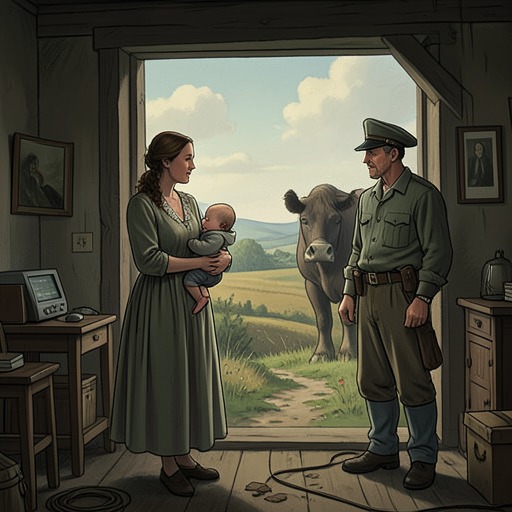
Gitta has spent fifteen years in a remote, demanding existence, raising children and maintaining the household while Geza is frequently away. At the smallholding in Nova Europa, the work includes tending the land, cooking, sewing, cleaning, and trying to make limited resources stretch. There is no telephone or electricity. Geza often returns only intermittently, with little money, leaving Gitta to carry the daily responsibilities largely alone. The contrast between this life and the future she once imagined gives her later choices a material context without excusing them.
Before marriage and exile, Gitta dreamed of becoming a ballet dancer, performing in Budapest or with the Vienna Opera Ballet. In Debrecen, she believed that a dance director had blocked her prospects by promoting a less talented rival. The narration also records her antisemitic resentment: she attributes the director’s later fate to divine punishment. Her anger and sense of lost possibility are presented alongside a broader indifference to Jewish persecution, not as a substitute for responsibility but as part of the moral portrait the book constructs.
Hiring a stranger
When Mengele arrives in Nova Europa under the name Peter Hochbichler, Gitta watches him closely. He rises early, works late, and attends carefully to the animals, but his manner and appearance seem out of place beside the labor expected on the plantation. He wears heavy boots and a buttoned-up white coat despite the heat, keeps a hat pulled low when approached, and tends his hands with unusual care. After a month, Gitta and Geza decide to keep him on. The decision begins as an arrangement with a needy, eccentric laborer, before the household understands whom it has admitted.
The discovery comes when Gitta enters Hochbichler’s unlocked room and searches among his belongings. She finds carefully folded designer clothes, an English umbrella, large amounts of cash, Spanish- and German-language newspapers and scientific journals, a padlocked notebook, papers she cannot decipher, opera recordings, and books by unfamiliar authors. These objects make the farmhand’s assumed identity harder to reconcile with the life he leads at the smallholding, but they do not by themselves identify him.
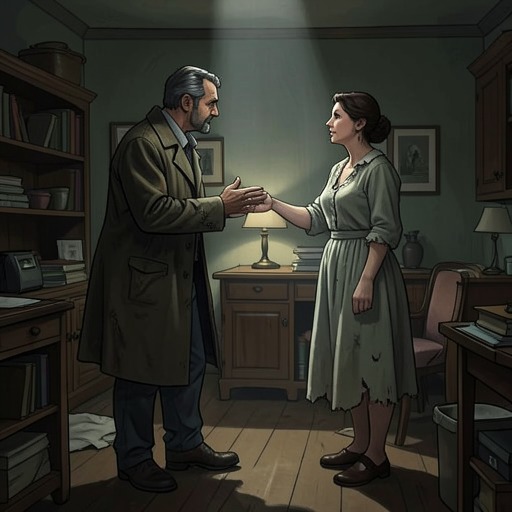
On 27 January 1962, a São Paulo newspaper marks the anniversary of the liberation of Auschwitz with a photograph of the fugitive Josef Mengele. Gitta recognizes the face: the eyes, eyebrows, gap between the front teeth, and shape of the forehead match the man known at the farm as Peter. She asks her eldest son, Roberto, to bring Hochbichler to her and shows him the picture. He leaves the room trembling and silent. That evening, after barely touching his meal, he admits to the Stammers that he is Mengele. He denies the crimes described in the press and attributes the accusations to Jewish influence. Gitta’s recognition thus leads not to a public exposure but to a private confirmation inside the household.
Care, intimacy, and material advantage
When Mengele later becomes seriously ill, Gitta tends him while Geza is away. He remains in bed, delirious and eating little; she brings soup and tea, airs the room, and applies cold compresses. Concerned that a war criminal might die in her home, she considers going for a doctor, but he regains enough strength to tell her not to. As she continues caring for him, she begins calling him Peter. The narrative then describes an intimate relationship that develops within this unequal situation, without presenting it as a romance or a change in his criminal past.
The arrangement also has a practical dimension. Gitta obtains money through her connection to Mengele and asks Gerhard for additional funds. She buys dresses in Serra Negra and leather satchels for her sons; a new bed arrives, and the house gains electricity. The narration places these improvements beside her years of deprivation and her dissatisfaction with Geza’s absences. At the same time, it shows how Mengele interprets the relationship strategically: he regards Gitta as a source of protection and believes that keeping her close helps him remain hidden. Their interests meet in the farm’s privacy, but they are not equivalent: she seeks resources and relief from an austere life, while he depends on the household as a refuge from capture.
Indifference and narrative significance
The Stammers’ response to Mengele’s identity is shaped by their own history of loss and displacement. Geza had studied in Germany during the war; the couple had experienced the loss of family property in Transylvania, Soviet occupation, and forced emigration. The book also makes clear that neither had been troubled by the persecution of Hungarian Jews or by violence carried out by the Arrow Cross. Their own suffering does not lead them to identify with the victims of Auschwitz. When the newspaper brings Mengele’s past into their home, they are indifferent to the accusations and want, above all, to be left in peace.
Gitta’s importance in the account lies in the sequence of her actions: she observes the stranger, accepts him into the household, uncovers evidence of a concealed life, recognizes his photograph, hears his admission, and continues living alongside him. The larger history she has entered is not ambiguous. Miklós Nyiszli’s account describes Mengele’s work in Auschwitz, including selections and experiments on twins; survivors later testify about the consequences of those experiments at the mock trial in Jerusalem. Against that record, the farm’s everyday routines and Gitta’s pursuit of comfort show how a fugitive’s concealment can depend not only on false names and remote surroundings but also on people willing to treat the crimes as someone else’s concern.